
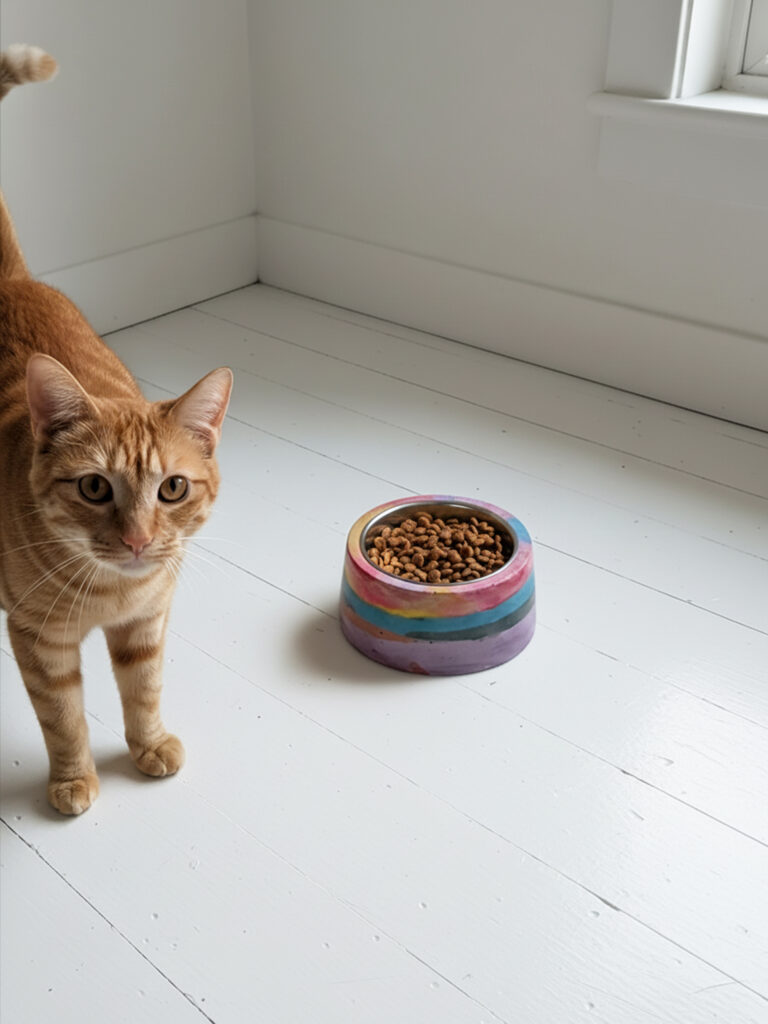
How Did “Whisker-Friendly Bowls” Come to Life? My Story
Let me be honest—when I first set out in 2022 to produce whisker-friendly pet bowls, I didn’t fully understand what “whisker sensitivity” even meant.
The only thing I knew was this: as a kid, I used to watch Jackson Galaxy without taking my eyes off the screen, and at some point he had added a whisker relief feeding bowl to his product line. I figured—if the “cat guy” himself included it, there must be something to it.
So I started digging. I looked into the brand Dr. Catsby—their products, their website, their claims. To be honest, at first glance it all felt more like a cleverly packaged cash grab than something truly necessary.
At home, I’m a cat parent to two—Saçak and Narin. They were both young at the time, with no weight issues, so I was free-feeding. My biggest frustration? The food at the bottom of the bowl was never finished. I constantly had to top it up, and eventually throw out the old kibble because it lost its smell and freshness. And well… we all know how expensive pet food is.
On top of that, Narin would always scatter food around the bowl. She’d carefully scoop kibble out with her paw and eat it off the floor. Back then, I assumed it was just play behavior and didn’t think much of it.
Until I started experimenting.
I tried different bowls at home—deep ones, shallow ones, wide plates, even feeding directly on the floor. And I noticed something: when I used shallow, wide dishes, these “problems” disappeared.
That’s when I became convinced that something like whisker sensitivity might actually be real.
From there, things moved quickly—finding a manufacturer, producing, launching… and before I knew it, whisker-friendly bowls existed where they hadn’t before.
(And yes, the name “Whisker-Friendly” was actually coined by @berraque—I’m still very grateful!)
So, What Is Whisker Fatigue? Myth or Real?
Let’s start with the basics.
A cat’s whiskers (vibrissae) aren’t just aesthetic details or cute accessories. They’re much thicker than regular fur, deeply rooted, and packed with nerve endings. In other words, they’re highly sensitive sensory tools—how cats “read” the world.
They use their whiskers to judge whether they can fit through a narrow gap, to sense depth, and even to detect subtle air movements.
So why don’t humans have them?
Because we rely on our hands, vision, and tools to navigate the world. Cats, on the other hand, evolved to survive in the dark, in tight spaces, moving quietly and quickly. Their whiskers allow them to feel without touching, measure without seeing, and understand without fully approaching.
Given how sensitive this system is, constant contact with hard, narrow surfaces can be uncomfortable for some cats. Deep bowls with steep sides can repeatedly stimulate the whiskers during feeding.
That’s where the idea of “whisker fatigue” comes in.
What Does Science Say?
This is where things get a bit complicated.
Whisker fatigue isn’t a universally agreed-upon, clearly defined medical condition. Some professionals support the idea, others think it’s overstated. There’s no full scientific consensus, and some veterinarians point out that it’s difficult to measure objectively.
But there’s also something we can’t ignore:
Cat whiskers are undeniably sensitive. Their anatomy, nerve structure, and function are well understood. So the idea that repeated contact with rigid surfaces could be uncomfortable for some cats doesn’t sound unreasonable at all.
And this is really the key point.
Whisker fatigue may not affect every cat. It may not be something we can diagnose with certainty. But there are behavioral clues:
- Leaving food at the bottom of the bowl
- Pulling food out with their paws
- Restlessness while eating
All of these can raise a simple question:
Could something about the bowl be bothering their whiskers?
In Short
The most honest way to put it might be this:
Whisker fatigue might be a myth for some cats—and a very real experience for others.
Since cats can’t give us verbal feedback, all we can do is observe and experiment.
That’s exactly where whisker-friendly bowls come in. They don’t promise a miracle solution—but they offer an alternative that may make feeding more comfortable for some cats.
That’s what we focused on.
In our own home, with our own cats, we experimented with shallower forms and wider edges—designs that don’t force whiskers to constantly press against surfaces.
The result?
Some cats never had an issue to begin with. But for others, the change was noticeable: they ate more comfortably, finished their food, and stopped (or reduced) the habit of moving kibble with their paws.
A Quick Note: Every Cat Is Unique
As much as we’d love simple answers, every cat has their own personality, preferences, and quirks.
That’s why I strongly recommend trying a similar-shaped dish at home before investing in a whisker-friendly bowl. The issue you’re experiencing might not be related to whiskers at all.
And let’s be honest—some cat behaviors will always remain a mystery.
Yes, your elegant cat may prefer a perfectly designed, whisker-friendly bowl for dry food… and still choose to drink water from your bedside glass at 3 AM.
There’s probably no stopping that. 🙂
Maybe they think they’re hunting. Maybe they’re exploring. Maybe “forbidden things are more appealing” is simply their life philosophy.
Or maybe your glass just tastes better.
Who knows?
At the end of the day, all we can do is accept and love them as they are.
Our Intention
With Püsküllü Saçaklı Whisker-Friendly Bowls, my goal is simple:
To take the small signals our cats give us seriously—and to improve their comfort where we can.
And to do that with designs that are not only functional, but beautiful enough to proudly display in your home.
With love.